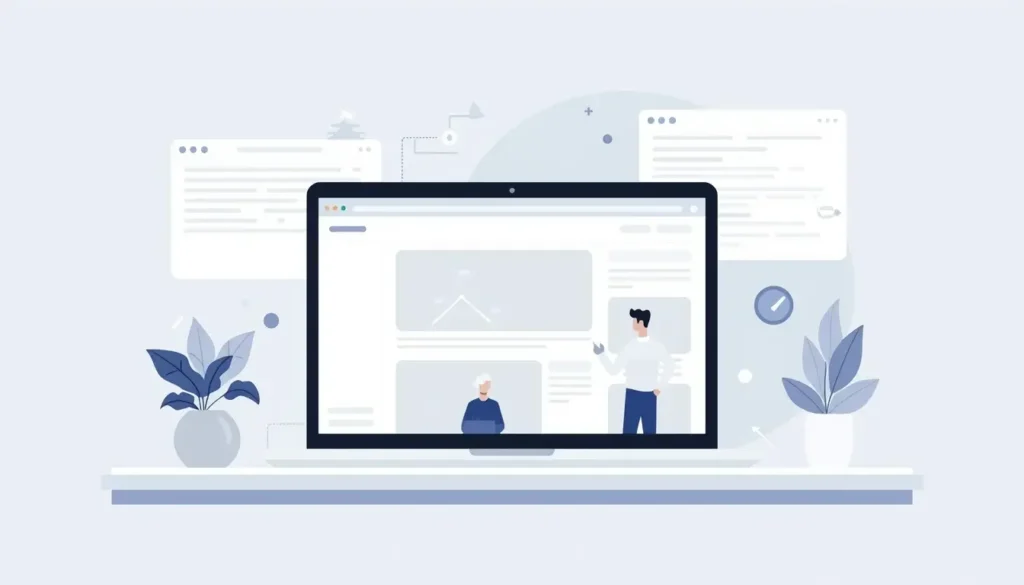
WebWishCreation.com is a WordPress-focused blog and service platform that I designed and developed from scratch using only free tools and free plugins. The purpose of this project was not just to launch another website, but to prove that a well-structured, scalable, and professional WordPress platform can be built without relying on premium themes, paid builders, or bloated plugin stacks.
The website serves two core purposes:
- Educational — publishing practical articles, tutorials, and fixes related to WordPress, Elementor, hosting, plugins, and site management.
- Service-Oriented — offering clear, accessible WordPress services with pricing, feature breakdowns, and consultation paths.
This project represents a realistic, production-level WordPress site built with discipline, planning, and performance awareness rather than shortcuts.
Goals & Constraints
From the beginning, I set a few strict constraints for this project:

- Use only free tools and plugins
- Keep the site easy to manage for non-technical users
- Design for content growth and SEO
- Avoid unnecessary visual complexity or plugin bloat
- Make services clear, understandable, and conversion-focused
These constraints forced me to think more like an engineer than a page builder—planning structure, reuse, and scalability before touching design.
Information Architecture & Content Structure
The website is structured as a content-first WordPress platform, with clear separation between educational content and service pages.
Key structural elements include:
- A blog system with categorized posts (CMS, Plugins & Themes, Domains & Hosting, Programming)
- Clean post layouts optimized for readability and long-form content
- Service sections with pricing tiers and feature comparisons
- Static pages such as About, Contact, Privacy Policy, Disclaimer, and Terms
Rather than relying on complex templates, I used WordPress-native content organization—categories, internal linking, and consistent heading structure—to ensure the site remains SEO-friendly and scalable as content grows.
Design & Page Building Approach
For the interface, I used Elementor (Free) with a strong focus on layout discipline. Instead of building every page differently, I relied on:
Image by Freepik
- Reusable layout sections
- Consistent spacing and typography
- Clear visual hierarchy
- Mobile-first responsiveness
Because the free version of Elementor has limitations, I carefully designed layouts that did not depend on advanced widgets or premium features. This required planning layouts in advance and designing within constraints, rather than relying on effects or animations.
The result is a clean, professional interface that prioritizes clarity, performance, and usability.
Plugin Strategy & Technical Decisions
One of the main challenges was choosing the right plugins without overloading the site. Every plugin added had to justify its existence.
My approach was:
- Use lightweight, well-maintained free plugins
- Avoid plugins that duplicate WordPress core functionality
- Prefer configuration and structure over feature-heavy plugins
By keeping the plugin stack minimal, the site remains faster, more secure, and easier to maintain. This also reduces the risk of conflicts and long-term technical debt.
Performance & SEO Considerations
Performance and SEO were treated as foundational requirements, not afterthoughts.
Key performance-focused decisions included:
- Clean HTML output through simple layouts
- Optimized image usage and sizing
- Minimal DOM complexity
- Avoiding unnecessary scripts and third-party assets
From an SEO perspective, the site is built with:
- Proper heading hierarchy (H1–H6)
- Internal linking between related articles
- Clear URLs and category structure
- Content layouts designed for long-form reading
This makes the site suitable for organic traffic growth and content expansion over time.
Service Integration & Conversion Strategy
Unlike a pure blog, WebWishCreation.com integrates services directly into the content ecosystem.
Instead of aggressive sales tactics, I focused on:
- Clear service descriptions
- Transparent pricing tiers
- Feature-based comparisons
- Free consultation CTAs
This allows readers to move naturally from learning → trust → inquiry, without disrupting the educational experience.
Challenges & Problem Solving
The biggest challenge was balancing functionality, performance, and flexibility without premium tools. This required:
- Careful layout planning
- Smart reuse of sections
- Accepting limitations and designing around them
- Making technical trade-offs intentionally, not accidentally
This project reinforced an important principle: good structure matters more than expensive tools.
Why This Project Matters
WebWishCreation.com demonstrates my ability to:
- Build a complete WordPress platform using only free resources
- Think in terms of architecture, not just visuals
- Combine content, services, and UX into one cohesive system
- Deliver professional, maintainable results under constraints
It complements my more custom-code and engineering-heavy work by showcasing a practical, WordPress-first approach suitable for real clients and real-world use cases.
Outcome
The final result is a fully functional, scalable WordPress blog and service website that is easy to manage, ready for content growth, and built with intention. This project proves that strong fundamentals, planning, and engineering mindset can outperform expensive tools when used correctly.